


Swiss design classics combine everyday practicality with a clear, recognisable form. Among the best-known household items in Swiss design is the Zena «Rex» paring knife, which has been well known since 1947 and appeared on a Swiss Post stamp in 2004. Swiss knives also stand for functional design and a long design tradition.
When choosing household items in Swiss design, you are not just looking at their appearance: handling, workmanship and their practical use in everyday life are equally important. Especially with classics, it is fascinating to see how a simple tool can become a piece of Swiss design history.
Here you will find out which knives and peelers shape Swiss design and what matters in terms of function and form. You will also get to know important brands and design studios and gain an overview of the differences between well-known classics. This will help you discover Swiss design that finds its place in everyday life while also telling a special story.
Key Takeaways
- The Zena «Rex» paring knife has been well known since 1947 and was honoured on a Swiss Post stamp in 2004.
- For knives and peelers, the right function and easy handling in everyday life are just as important as their form.
- Swiss design classics range from kitchen tools to residential objects. Compare how design and practical utility work together.
- Brands and design studios shape Swiss industrial design using different approaches. Discover the names and works behind them.
- When choosing household items, it is worth taking a closer look at the material, workmanship and intended use before deciding on a piece.
Knives and Peelers
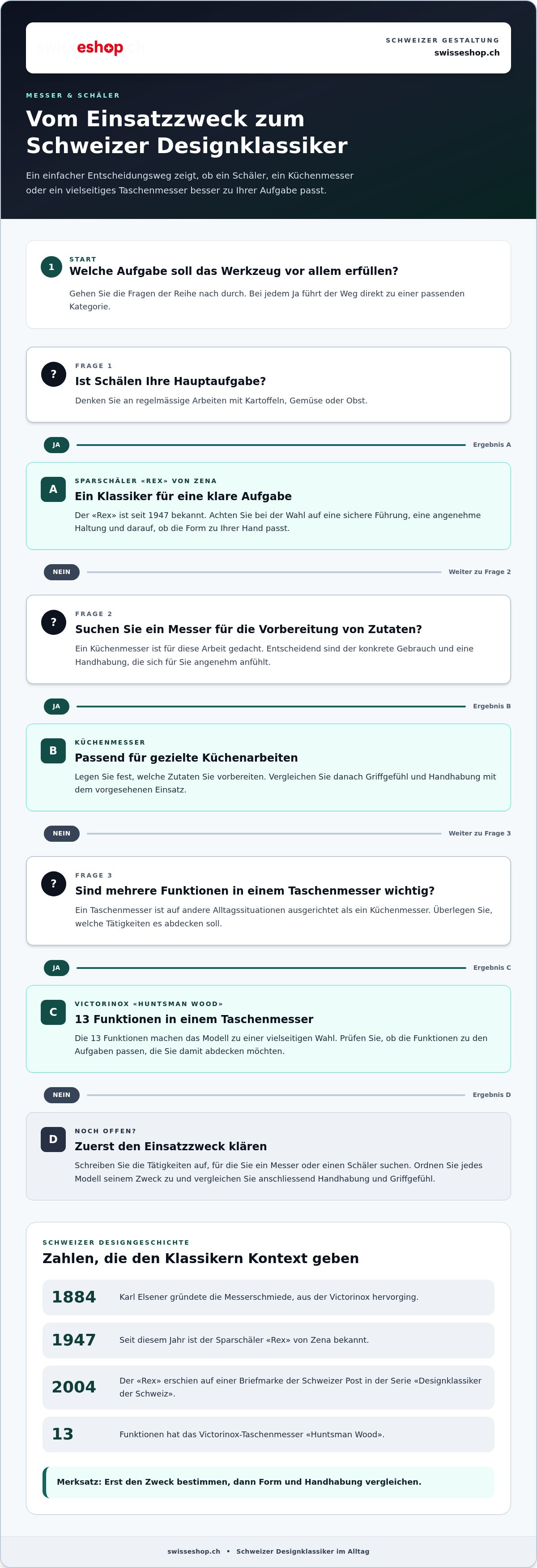
The Zena «Rex» paring knife is one of the well-known classics of Swiss design. Since 1947, its name has stood for an everyday item with a high degree of recognition. Its history shows how a simple kitchen tool can make design history. In 2004, the REX paring knife appeared on a Swiss Post stamp. The stamp was part of the «Swiss Design Classics» series. This made the peeler itself the subject of a national tribute.
With a peeler, the task comes first: Which ingredients do you prepare regularly? The grip and movements differ for potatoes, vegetables or fruit. When buying, pay attention to secure control and a comfortable hold. An ergonomic paring knife allows for comfortable, strain-free handling. Also check whether the shape suits your hand. This way, even a short task will not become unnecessarily cumbersome.
Knives also deserve a clear classification according to their purpose. A kitchen knife is used to prepare ingredients; a pocket knife is designed for other everyday situations. Victorinox combines Swiss knife history with widespread recognition. The «Huntsman Wood» model has 13 functions. This number makes it clear why a pocket knife is not automatically a substitute for every kitchen knife. What matters is which task the knife is intended to perform.
Do not compare knives based on their name alone. First decide whether you want to cut, peel or cover several tasks. Then check the feel of the handle, handling and intended use. A single kitchen knife can be useful for specific tasks. A pocket knife with several functions is more likely to appeal to people who value versatile tools. The right companion is the one whose purpose suits your everyday life.
Swiss design shows itself in different ways at Zena and Victorinox. The «Rex» is a paring knife with a clearly defined task. The «Huntsman Wood» stands for a pocket knife with several functions. Both examples show that design does not have to be merely decorative. Form, handle and use go together. An object is convincing when its design makes its use clear.
A simple process helps with a practical selection. First write down the tasks for which you are looking for a knife or peeler. Then assign each model to its purpose. Next, compare the handling and check whether the tool feels comfortable in your hand. With a peeler like the «Rex», daily use is what matters. With the «Huntsman Wood», it is worth looking at the 13 functions.
History can also play a role in the choice. The 2004 stamp anchors the «Rex» in Swiss design history. Victorinox was founded on a knife forge established by Karl Elsener in 1884. Such connections turn a consumer item into a piece of Swiss design with a story to tell. This is particularly interesting when a knife or peeler is intended as a gift.
Whether you are looking for a peeler for the kitchen or a knife for versatile tasks: Start with the intended use. Zena and Victorinox show two different approaches to Swiss knife culture. The «Rex» stands for a familiar peeler shape, while the «Huntsman Wood» stands for 13 functions in a pocket knife. If you consider this difference, you will compare more appropriately and choose more effectively.
Prices of Swiss Design Classics
Swiss design classics differ greatly in material, function and manufacturing effort. A Victorinox Damascus carving knife performs a different task than a SIGG drink bottle. The Stöckli Titlis fondue set and the fire ring also belong to different product groups. A single comparison therefore says little about the value of an object. What is more meaningful is how design and practical utility come together.
With a knife, the choice of material, workmanship and construction influence its classification. A carving knife must be able to be guided precisely when cutting. With the Damascus model from Victorinox, the special material designation is already the focus. Therefore, consider what task the knife is intended to perform regularly. For occasional use, a different aspect matters than for daily kitchen work. This makes the comparison more concrete.
With a SIGG bottle, it is worth looking at the intended use and design. A bottle accompanies everyday life differently than a fondue set from Stöckli. The latter is used during shared meals and can be part of the table setting. Therefore, do not compare items from the same brand alone. First classify them by function, frequency of use and personal utility.
A fire ring shows that even larger design objects require their own consideration. Space requirements, intended use and the design of the outdoor area all play a role. With the Stöckli Titlis fondue set, shared meals and the table setting are again the focus. Such examples make it clear: A meaningful comparison begins with the question of what the object is intended to do.
These steps help with your own assessment:
- Determine the function: Assign the Victorinox Damascus carving knife, SIGG bottle and Stöckli set to their respective uses.
- Consider the workmanship: Pay attention to how the material and form support the intended use.
- Classify the design: Check whether timeless design and personal preferences match.
- Consider everyday use: Ask yourself how often you will actually use the object.
These steps make it easier to compare offers, even if the products are different. A high-quality kitchen knife is judged by different criteria than a bottle. With the fire ring, the planned outdoor use is what matters. With the Stöckli set, function and the shared table ritual are central. The right decision depends first on the utility, not solely on the well-known name.
A design classic can also gain special significance as a gift. Victorinox, SIGG and Stöckli each stand for their own Swiss design traditions. Choose an object whose function suits the recipient's everyday life. This combines timeless design, practical use and personal appreciation. This combination makes Swiss design classics interesting far beyond their outward appearance.
The Victorinox Damascus carving knife is offered for approximately 650.-, SIGG drink bottles for approximately 17.- and the Stöckli Titlis fondue set for approximately 129.-. The price of the fire ring is available on request.
Swiss Industrial Design
Swiss industrial design combines design with concrete everyday tasks. The Stewi clothesline was introduced in 1947. Huldreich Altorfer designed the Embru deck chair in 1948. Both examples show how household and leisure items are designed in a practical and distinctive way. Their form becomes clear through use. This way, design is not only observed but also experienced in everyday life.
The SRF series «DESIGNsuisse» profiles 25 designers from Switzerland. It provides insights into different disciplines and working methods. An episode about Carmen and Urs Greutmann covers furniture and industrial design. It lasts 12 minutes. The episode about Yves Béhar, a Swiss industrial designer, lasts 11 minutes. Both profiles show how differently design focuses can develop.
Awards offer another way to access concrete designs. The Wave drawer insert set received the reddot Award in 2019. The stand garlic press was honoured with the Good Design Award in 2018. Such recognitions give a design a public classification. For your own assessment, it remains crucial whether form and function suit the use. An award alone does not explain how well an object fits into everyday life.
Furniture also shows how closely design and use are connected. The Embru deck chair, designed by Huldreich Altorfer, is an example of a design focused on a concrete activity. Compare furniture based on its intended use. A seat fulfills different tasks than a drawer insert. The comparison becomes more meaningful if you first consider the function.
These questions help when looking at a design:
- Function: What task does the object perform in the home or living area?
- Form: How does the design support the intended use?
- Working method: What design focuses do the profiles in the «DESIGNsuisse» series show?
- Recognition: What does an award say about the design and what does it not?
These questions help to distinguish practical suitability from personal taste. With the Wave drawer insert set, the organizing function is immediately recognisable. The Stewi clothesline belongs to household chores, while the Embru deck chair is used for sitting. Such examples make industrial design tangible. At the same time, they show that Swiss design covers various areas of everyday life.
Anyone who wants to delve deeper into Swiss design can compare profiles and objects. «DESIGNsuisse» introduces different designers. The works of Greutmann, Béhar, Stewi and Embru show different perspectives on design. Pay attention to the task, form and use in each example. This way, you will develop your own approach to industrial design and recognise how a design shapes everyday life.
Swiss Brands and Design Studios
Swiss product design is created by established brands and specialised studios. Victorinox dates back to the knife forge established by Karl Elsener in 1884. The company is a striking example of a brand whose name is closely associated with Swiss knife culture. However, a long history alone does not explain a design. Function, material and daily use also shape the design of an object.
Design studios bring a different perspective. The Ticino-based studio Theredbox stands for independent design work from Switzerland. An episode of the «DESIGNsuisse» series introduces the studio and lasts 12 minutes. It shows how a design practice can be understood through concrete projects. Pay attention to the form, area of use and the way a design addresses an everyday problem.
Alexis Georgacopoulos is also one of the names Swiss design enthusiasts can get to know. The corresponding episode of «DESIGNsuisse» lasts 11 minutes. It provides an introduction to his work and personal approach to design. For comparison with a brand like Victorinox, a simple question helps: Does the object originate from a long-established product world or from individual studio work?
Another profile is dedicated to the furniture maker Ramòn Zangger. The episode lasts 12 minutes and focuses on furniture design and craftsmanship decisions. With furniture, proportions and intended use can be particularly well compared. Robust design does not only mean a sturdy appearance. What matters is whether the construction and form suit the planned use.
Brand and studio are not interchangeable terms. Victorinox is an established Swiss brand with roots in knife-making craftsmanship. Theredbox stands as a Ticino-based design studio for a different organisational form. Alexis Georgacopoulos and Ramòn Zangger, in turn, are profiled as individual designers. These differences help to better classify names and achievements.
When getting to know Swiss design creators, use a clear comparison:
- Brand: Check which product world Victorinox represents and what story goes with it.
- Studio: Pay attention to the projects presented by Theredbox and their use.
- Designer: Compare the profiles of Alexis Georgacopoulos and Ramòn Zangger.
- Everyday life: Ask what task a design solves and how its form helps with this.
The three profiles last 11, 12 and 12 minutes. This allows them to be watched individually and then compared. Start with the topic that interests you most: studio work, furniture or an established brand. Then write down which forms and functions stand out to you. This way, you will develop your own perspective on Swiss brands and studios, rather than just recognising well-known names.
The same approach applies to household items. A brand can build trust with its story; a studio can impress with an individual design idea. In both cases, what matters is whether the design fulfils a clear purpose. Victorinox, Theredbox, Alexis Georgacopoulos and Ramòn Zangger offer different approaches. Their names make Swiss design diverse and concrete.
What materials and quality standards do Swiss household item manufacturers use?
Swiss household items are made from different materials. Victorinox knives, SIGG bottles and Stewi clotheslines fulfil different tasks. Therefore, there is no uniform material standard for every product group. What matters is whether the material and workmanship suit the respective use. A knife has different properties than a bottle or a clothesline.
First check the product information about the material. With a kitchen knife, it is interesting to know what the blade and handle are made of. With a SIGG bottle, you should read the stated material information. With a Stewi clothesline, the construction is the focus. Such information helps to compare products according to their function, rather than inferring certain properties from the Swiss brand name.
Quality standards also depend on the object. An award for design is not automatically a material or safety certification. This is shown by the comparison between a Victorinox knife and the Wave drawer insert set, which received a design award. Therefore, assess them separately: What does an award say about the design? Which product specifications describe the material and workmanship? This way, you do not equate different quality statements.
A clear process helps with your own assessment. Read the material description, consider the connection of individual parts and compare the workmanship with the intended use. With a knife, for example, check whether the handle and blade appear suitable for the planned kitchen work. With a clothesline, consider the construction and handling. This way, you assess function and material together.
- Material specification: Read the description of the specific model, for example with Victorinox or SIGG.
- Workmanship: Pay attention to clean transitions and how the parts are joined together.
- Application: Do not compare a kitchen knife using the same criteria as a Stewi spin dryer.
- Evidence: Distinguish between material information, quality specifications, and design awards.
A seal of quality should always be considered in the context of its scope. Ask yourself whether it refers to material, manufacturing, or design. For example, the reddot Award for the Wave drawer insert set is a design award. This does not make a statement about every material used. This distinction protects against exaggerated expectations and makes product comparisons more objective.
Ultimately, the concrete everyday use counts when making a purchasing decision. A frequently used knife should be suitable for handling and the task at hand. A SIGG bottle is judged by its intended use. With the Stewi spin dryer, the construction is relevant for its respective application. Swiss origin alone does not replace this check. Material specifications, workmanship, and function together form a comprehensible basis.
Anyone comparing household items can apply these criteria to any product. Start with the material description, then check the workmanship and correctly interpret quality marks. A Victorinox knife and a SIGG bottle can thus be assessed fairly, although they serve different purposes. The best choice is the one whose verifiable properties suit your use.
Swisseshop.ch: Gifts with Swiss Affinity
Swisseshop.ch offers gifts with Swiss affinity for personal occasions and business gestures. Anyone looking for a souvenir with a connection to Switzerland will find souvenirs and Swiss chocolate. For companies, personalized promotional gifts are suitable if a token of appreciation is also intended to make their own brand visible. This makes it possible to select a gift that is appropriate for the occasion and recipient.
The featured knives, peelers, and design objects show how Swiss design combines function and origin. However, a gift does not have to be a design classic to express the Swiss way of life. Swiss chocolate or a souvenir can also be a suitable gesture. Discover the selection on swisseshop.ch if you are looking for a gift with a Swiss connection.
Choose Swiss Design for Your Everyday Life
With household items in Swiss design, how well design and use fit together counts. Choose a piece that serves you in everyday life and at the same time tells a story. With a gift, the personal connection can also be crucial.
In addition to gifts with Swiss affinity, Swisseshop.ch also offers Swiss chocolate and souvenirs. This allows you to gift the Swiss way of life in a different way. On special occasions, it is not just the object that counts, but also the thoughtfulness behind it.
Think about who you want to make happy and what suits that person. An everyday-suitable piece, a sweet token, or a souvenir can each add the right touch. In this way, Swiss design becomes a personal gesture.
Discover your own connection to Swiss design and joyfully choose a piece that gains meaning in everyday life.
Swisseshop.ch curates gifts with Swiss affinity, souvenirs, and Swiss chocolate. Discover our selection of Swiss promotional gifts for special occasions.
Frequently Asked Questions
Which Swiss brands offer household items with Swiss design?
Bamix and Schlossberg are other Swiss names in the household and home sector. Bamix is known for hand blenders, Schlossberg for Jersey Stretch Fix laundry cloths. Both complement the well-known examples from knife and peeler design. Check the country of origin and product description for every item. Note down which product group you are looking for before comparing. This allows you to distinguish between brand affiliation, concrete use, and personal taste and to select more specifically.
What typical household items are available in Swiss design?
The range of household items also includes storage containers, cutting boards, kitchen graters, and table accessories. They support different processes: storage containers organize ingredients, cutting boards create a work surface, and table accessories complement the meal. Think about which activity you want to make easier. Then search specifically for a suitable product group and match its design to your interior or kitchen routine.
What characterizes Swiss design in household items?
The term can refer to a Swiss brand, a Swiss designer, or a Swiss designer. On its own, it does not necessarily indicate where an item was manufactured. Therefore, read the information about the brand, design, and manufacturing separately. This distinction helps to appreciate the Swiss design tradition while also better understanding the actual origin of the individual object.
Where can you buy Swiss design household items in Switzerland?
Swisseshop.ch offers household and kitchen items in its online shop. When shopping, you can narrow the search to the desired product group and then read the information about the individual item. Pay attention to whether the description explains the design, brand, or origin. This information helps you choose what is suitable for your own household or as a gift.
How much do Swiss design household items cost in Switzerland?
For budget planning, it is best to compare items from the same product group and with a similar design. For a set, check which components are included. For multiple variants, you should compare the selected design in each case. This prevents you from equating different contents or product types. Decide before searching which properties are crucial. This keeps the comparison clear and appropriate for the intended use.
Which Swiss online shops and specialty stores carry household items with Swiss design?
Swisseshop.ch carries household and kitchen items in its online range. First determine what type of object you are looking for, and then read the descriptions of the suitable items. When planning a gift, the occasion can also help with the selection. This allows you to combine the search for Swiss design with a concrete purpose, rather than relying solely on a well-known brand name.
split:
Instagram
Share via Instagram
Copy the link, then open Instagram and add it to your Story using the Link sticker. You can open the image and save it first. This does not publish a post automatically.
Open image to saveOpen InstagramInstagram
Share via Instagram
Copy the link, then open Instagram and add it to your Story using the Link sticker. You can open the image and save it first. This does not publish a post automatically.
Open image to saveOpen InstagramGift ideas for men by interest and occasion
Swiss heritage products for gifts and everyday life